
Choosing the Right Wet Insulation Removal OKC Company
Why Wet Insulation Removal in OKC Is Not a DIY Job
Wet insulation is one of the most damaging things that can stay hidden inside an Oklahoma City home. It holds moisture against wood framing, accelerates mold growth, and loses all thermal value the moment it gets saturated. The longer it stays in place, the more expensive the repair bill becomes.
Learn more about mold remediation Oklahoma City in Mustang, OK
Learn more about certified mold inspection OKC
Learn more about burst pipe water damage repair Oklahoma City
What Happens Inside the Wall or Attic When Insulation Gets Wet
Fiberglass batt insulation is not waterproof. It traps moisture between the fibers and holds it for weeks without visible signs on the surface. Cellulose insulation is worse: it is made from paper-based materials that absorb water like a sponge, compress under their own weight when wet, and provide an ideal food source for mold spores. Spray foam, by contrast, does not absorb water, but water can still migrate along the foam's edges and saturate adjacent framing.
In an OKC home after a roof leak, pipe burst, or storm intrusion, insulation in the attic or wall cavities can hold enough moisture to keep the framing behind it above 20 percent moisture content for 30 days or more. That is well above the threshold where wood rot and mold become active problems.

Why OKC's Climate Makes This Worse
Oklahoma City summers combine high ambient humidity with extreme heat. Attic temperatures in July and August regularly exceed 140 degrees Fahrenheit. That heat drives moisture vapor deeper into structural cavities rather than drying them out. Meanwhile, the humidity outside keeps interior relative humidity elevated, slowing evaporation further. Wet insulation that might dry naturally in a drier climate will stay wet for months in an OKC attic without active intervention.
The Mold Clock Starts Immediately
The EPA's guidance on mold is clear: mold can begin colonizing wet organic material within 24 to 48 hours under warm, humid conditions. Cellulose and fiberglass batts backed with kraft paper both qualify as organic material. A roof leak that soaks attic insulation on a Monday morning in June can produce visible mold colonies on rafters by Wednesday if nothing is done. That is not an exaggeration for OKC's climate. It is the realistic timeline that drives every response decision.
How to Evaluate a Wet Insulation Removal Company in OKC
Not every company that offers water damage services has the equipment or process knowledge to handle wet insulation correctly. Here is what actually separates qualified contractors from those who will leave hidden moisture problems behind.
Equipment They Must Bring to the Job
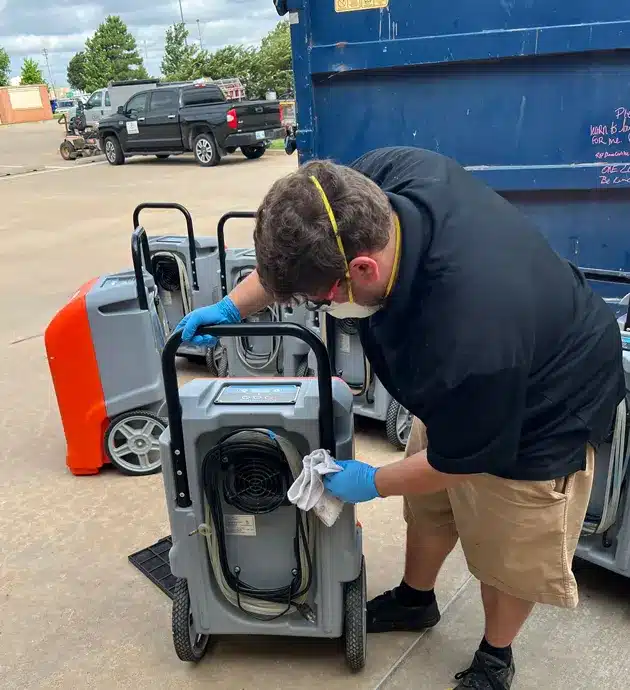
The right equipment is non-negotiable. A qualified wet insulation removal company in OKC should arrive with commercial LGR dehumidifiers, air movers, and moisture meters capable of reading framing, drywall, and subfloor independently. Truck-mounted or portable negative air machines with HEPA filtration are required when mold is present or suspected, to prevent spore dispersal into living areas during removal.
Consumer shop-vacs and residential box fans are not adequate tools. If a contractor shows up without calibrated moisture meters and commercial drying equipment, the job will not be completed to the standard required to prevent recurring mold and rot.
Key equipment a legitimate OKC wet insulation removal company should have on the truck:
- Commercial LGR dehumidifiers rated for 150 or more pints per day
- High-velocity air movers to accelerate evaporation from structural cavities
- Thermal imaging cameras to locate moisture hidden behind intact surfaces
- Pin and pinless moisture meters calibrated for wood and drywall
- HEPA negative air machines for containment during mold-present removal

Process Standards That Protect You
Ask any OKC contractor which drying standard they follow before you hire them. The IICRC S500 Standard for Professional Water Damage Restoration defines the acceptable moisture content thresholds for structural drying. Reputable companies document daily moisture readings on a drying log so there is a written record that the structure reached drying goals before insulation replacement begins. Without that documentation, you have no proof the job was done correctly, which matters significantly if an insurance claim is involved or mold returns later.
Never allow insulation to be re-installed until a moisture reading confirms framing is below 16 percent. Insulating over wet framing traps moisture and guarantees mold growth.

Red Flags That Signal an Unqualified Contractor
Watch for contractors who quote a flat price over the phone without inspecting the affected area, who cannot explain what moisture content target they are drying toward, or who propose to bag wet insulation and re-install it after drying. Wet insulation that has been compressed or contaminated must be disposed of, not reused. Also avoid companies that skip containment when removing insulation from mold-affected areas. Uncontrolled removal spreads spores through the HVAC system and into living spaces.
Why OKC Property Owners Call Priority Restoration for Wet Insulation Removal
Speed determines how much structural damage you end up with after water reaches your insulation. Priority Restoration OKC dispatches crews 24 hours a day across OKC, Norman, Edmond, and Mustang with the commercial drying equipment needed to stop moisture migration before it reaches framing, subfloors, and wall cavities below the affected area.
Every wet insulation removal job starts with a thermal imaging scan and moisture mapping so we know exactly where water has traveled, not just where it is visible. Insulation removal is followed immediately by structural drying with commercial LGR dehumidifiers and air movers placed directly in the affected cavities. Daily moisture logs document progress until drying goals are reached.
We work directly with insurance carriers and provide full documentation for claims. Free estimates are available. If you are dealing with wet insulation right now from a roof leak, burst pipe, or storm, call 405-357-1881 immediately. Every hour matters.
We serve OKC, Norman, Edmond, Mustang, and surrounding areas around the clock, every day of the year.
FAQs
The most reliable way is a thermal imaging camera scan combined with moisture meter readings. Visually, saturated fiberglass batts appear darker, clumped, or sagging from the framing. Cellulose insulation will compact and darken noticeably. In attics, you may see staining on rafters above or below the insulation. A musty odor in the affected room, even without visible damage, is a strong sign that moisture has been sitting long enough for microbial activity to start. Do not rely on a visual inspection alone. Moisture travels laterally through insulation and can affect areas several feet beyond the visible wet spot.
In rare cases involving thin fiberglass batts and very minor moisture exposure in a dry, well-ventilated space, partial drying may occur. In Oklahoma City's climate, this almost never happens within the timeframe that prevents mold growth. Cellulose insulation essentially never recovers its original R-value or dries adequately once saturated. Attempting to dry insulation in place without removal typically means covering wet framing, which guarantees mold and wood rot. Professional removal and structural drying is the only reliable path to a clean, dry structure.
It depends on the cause. Sudden and accidental water damage from a burst pipe or a roof leak caused by a storm is typically covered under standard homeowners policies, including the cost of removing and replacing damaged insulation. Gradual leaks, flooding from external surface water, or damage from lack of maintenance are generally excluded. Sewer or drain backup coverage requires a separate policy endorsement with most carriers. Document everything with photos before any material is removed and call your insurer before work begins if possible. Priority Restoration provides full documentation to support insurance claims.
Physical removal of wet insulation from an attic or wall cavities typically takes four to eight hours depending on square footage and access. Structural drying of the exposed framing, sheathing, and subfloor material usually runs three to five days with commercial dehumidifiers and air movers in place. Oklahoma City's summer humidity can extend that timeline. Technicians take moisture readings daily and move equipment as needed to reach drying targets. New insulation should not be installed until framing moisture readings confirm the structure is dry, which is verified with a final moisture log.
Blown cellulose is the most problematic. It is common in OKC attics installed over the last 30 years because it offers good R-value per inch and fills irregular spaces well. But cellulose is paper-based and absorbs water aggressively, compresses under its own weight when wet, and provides an excellent growth medium for mold. Fiberglass batts are second most common and hold less water, but still trap enough moisture against framing to cause damage. Kraft-faced batts are particularly problematic because the paper facing holds moisture directly against the wood. Spray foam performs best when wet but still requires inspection of adjacent materials.
Yes, in several ways. Crawlspace access is often limited to 18 to 24 inches of clearance, which makes removal physically harder and slower. Fiberglass batts hung between floor joists in a crawlspace fall when saturated and often collect on the ground below, where they hold moisture against soil and concrete block piers. Crawlspace conditions also involve ground moisture vapor, which continues reintroducing humidity even after the insulation source is removed. A proper crawlspace wet insulation job requires encapsulation or at minimum a vapor barrier replacement after drying, not just insulation removal. See our crawlspace water removal page for details on that process.
Mold in wall cavities almost never shows on the surface until growth is extensive. The first sign is usually a musty odor that persists even after the obvious moisture source is fixed. A thermal imaging scan can show temperature differentials that indicate wet framing behind intact drywall. Borescope inspection through a small drilled hole allows a direct visual without full demotion. If a pipe leak soaked wall insulation and more than 48 hours passed before drying began, treat mold as present and plan accordingly. Testing is available but often the physical evidence from inspection is sufficient to guide remediation scope.
Yes. Wet insulation removal is part of nearly every water damage restoration job we handle where structural cavities are involved. We do not treat it as a separate add-on. Extraction, insulation removal, structural drying, and mold assessment are coordinated as a single process. We serve OKC, Norman, Edmond, Mustang, and the surrounding metro area 24 hours a day. When you call 405-357-1881, you reach a live person who can dispatch a crew immediately. Free estimates are available for every job.