
Hail Damage Roof Water Intrusion Oklahoma City: What to Expect
How Hail Damage Creates Roof Water Intrusion in Oklahoma City
Hail damage rarely causes an immediate, obvious leak. What it creates is a compromised barrier that allows water intrusion the next time it rains, sometimes weeks after the storm. Oklahoma City homeowners need to understand that sequence to respond correctly.
Learn more about certified mold inspection OKC
Learn more about flooded basement cleanup cost oklahoma city
What Hail Actually Does to Asphalt Shingles
Hail impact dislodges the granules embedded in asphalt shingles. Those granules are not decorative. They block UV radiation and protect the asphalt mat underneath. Once knocked loose, the mat is exposed and deteriorates rapidly, especially under Oklahoma's intense summer sun. Within one to three rain cycles, the softened mat develops micro-fractures that let water migrate under the shingle layer.
Larger hail, one inch and above, can crack the mat on impact. That is an immediate water intrusion path. Oklahoma City regularly sees hail in that size range during spring and early summer severe weather events, particularly in the OKC metro corridor where storm cells track northeast.

Flashing, Vents, and Skylights: Where Hail Opens the Biggest Gaps
Hail does not just hit flat shingle surfaces. It strikes metal flashing around chimneys, pipe boots, valleys, and ridge caps. A direct hit can lift or crack flashing that was previously sealed. Rubber pipe boots crack on impact, and even a small split becomes a direct water entry point. These are the areas that often show intrusion first because they were already the most vulnerable spots on the roof.
Why OKC Homes Are Hit Hard by Hail Events
Oklahoma sits within Tornado Alley, and the Oklahoma City metro specifically falls in one of the highest-frequency hail corridors in the country. The National Weather Service Oklahoma City office tracks multiple significant hail events across the metro each year. Homes in Norman, Edmond, Mustang, and the OKC core all see repeated exposure. Roofs take cumulative hits across multiple seasons, so a roof that survived last spring may fail this fall after one more event weakens already-compromised shingles.
What Water Intrusion Damage to Expect After Hail Hits Your OKC Roof
The damage sequence after hail damage roof water intrusion in Oklahoma City follows a predictable pattern. Knowing each stage helps you act before the next one starts.
Attic, Insulation, and Ceiling Damage
Water entering through a compromised shingle or cracked flashing first saturates the roof deck. From there it moves into the attic insulation. Saturated blown-in insulation loses nearly all of its R-value and becomes a medium for mold growth. Batted fiberglass holds moisture against the wood framing above the ceiling drywall, which accelerates rot in the rafters and top plates.
Once water gets past the insulation layer, it spreads laterally across the ceiling drywall. Homeowners often notice a stain that is several feet wide and several feet away from the actual entry point. That gap confuses people. The roof breach and the ceiling stain are rarely in the same location because water travels along rafters and sheeting before dripping down.
Common damage documented after hail-related roof water intrusion in Oklahoma City includes:
- Roof deck sheathing with softened or delaminated areas requiring replacement
- Attic insulation that is saturated, compressed, or showing visible mold
- Ceiling drywall with water stains, bowing, or active dripping
- Wall framing and top plates where water has tracked down from ceiling level
- Interior finishes including paint, drywall tape, and in severe cases, flooring below

Mold Risk After Roof Water Intrusion
Mold can begin colonizing wet attic framing and insulation within 24 to 48 hours under Oklahoma's warm, humid conditions. The EPA's mold guidance is clear that wood framing, drywall paper, and insulation facing are all ideal mold substrates once wet. Attics are particularly dangerous because they are enclosed, trap heat, and often go unexamined for days or weeks after a storm. By the time a stain appears on a bedroom ceiling, mold may already be active on the back side of the drywall above it.
If your roof was hit by hail and you have seen any ceiling discoloration, every additional hour matters. Do not wait for the stain to grow before calling.

What the Water Mitigation Process Actually Involves
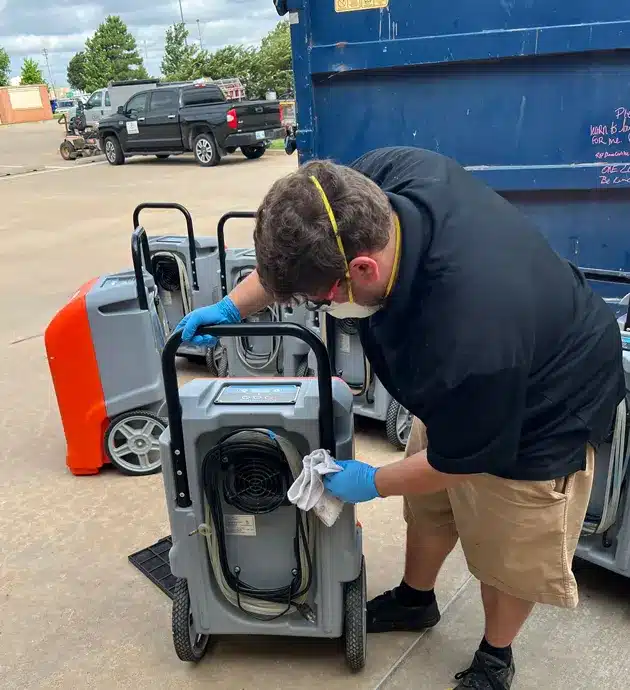
When a restoration crew responds to hail damage roof water intrusion in Oklahoma City, the first priority is stopping active water entry. That usually means emergency tarping or temporary patching of the roof breach. Then comes moisture mapping with thermal imaging cameras and pin-type moisture meters to find exactly where water has migrated, including hidden areas inside wall cavities and ceiling assemblies. Equipment placement for drying depends entirely on what the moisture readings show, not on what is visually wet. Commercial LGR dehumidifiers and air movers are positioned to pull moisture out of framing and drywall before removal decisions are made. Daily readings track progress toward industry drying standards set by the IICRC S500.
What to Do Right Now If Your Oklahoma City Roof Is Leaking After Hail
Your first call after hail damage roof water intrusion in Oklahoma City should be to a restoration contractor, not a roofer. A roofer patches the opening. A restoration contractor identifies how far the water has already traveled and dries the structure before mold sets in. You need both, but in that order.
Do not place buckets under drips and wait for the roofer's schedule to open up. Active water migration into framing and insulation is happening during that wait. The longer it goes unaddressed, the more material requires removal and replacement, which directly increases your out-of-pocket cost and your insurance claim scope.
Priority Restoration OKC responds 24 hours a day, every day, to hail damage water intrusion calls across Oklahoma City, Norman, Edmond, and Mustang. We deploy with moisture detection equipment, extraction gear, and temporary weatherproofing materials. Free estimates are available. Call 405-357-1881 now.
FAQs
Granule loss shows up as dark patches on shingles or a heavy accumulation of granules in your gutters and downspout splash areas after a storm. Dents on metal ridge caps, flashing, and gutters are usually visible from the ground with binoculars. Soft spots in the shingle mat and cracked rubber pipe boots require a close inspection. If hail was confirmed in your area and your shingles are more than ten years old, treat your roof as compromised until it is physically inspected. Oklahoma City sees enough hail events that insurance adjusters recognize the damage pattern well.
Yes, delayed staining is common. Hail damage often creates a path that only allows significant water intrusion under heavier rain. If the first rain after the hailstorm was light and the stain appeared after the next heavier rain, the connection is very likely. Insurance adjusters are familiar with this pattern. Document the hail event date with local weather records and photograph both the roof damage and the interior staining to support your claim.
Standard homeowners policies in Oklahoma typically cover hail damage to the roof and resulting interior water damage as a sudden and accidental loss. The critical factor is proving the water intrusion resulted from the hail event rather than pre-existing wear. That is why thorough documentation immediately after a storm matters. Some policies have separate hail deductibles, often calculated as a percentage of the dwelling coverage rather than a flat dollar amount. Review your declarations page and call your carrier the same day you discover damage.
In most cases, no. Ceiling drywall that has been saturated from above is wet on both faces and cannot be dried effectively without removing the insulation above it first. Running fans below a wet ceiling pushes air across the visible face but does nothing for the back side or for the framing and insulation above. Mold grows on the back side where moisture is trapped. A restoration technician measures moisture content in the framing and sets a drying goal. If those readings do not come down within a defined window, material removal is the only path to clearance.
Move any furniture, electronics, and stored items out from under the active drip area. Place a waterproof tarp or plastic sheeting over what cannot be moved, but do not go onto the roof yourself during or after a storm. Take photographs and video of all visible damage, both on the roof from ground level and inside the affected rooms. Note the date and time. Call your insurance company to open a claim, then call a restoration contractor at 405-357-1881. Getting moisture readings taken quickly determines how far the water has spread and what equipment is needed.
Drying time depends on how long the water was present before equipment was set, how much insulation was saturated, and what the ambient humidity is in the space. Attic framing and ceiling assemblies often take three to five days of continuous commercial drying to reach acceptable moisture levels. Oklahoma's summer humidity slows that process. Daily monitoring with a pin-type moisture meter tracks progress. The drying phase is complete when framing reaches equilibrium moisture content, typically below 16 to 19 percent for wood framing, not simply when things feel dry to the touch.
Yes. We provide detailed moisture mapping records, equipment placement logs, and daily drying readings that insurance adjusters require to process a claim accurately. This documentation shows what was wet, how wet it was, what drying protocol was used, and when clearance was achieved. That paper trail protects you if the carrier questions the scope of work. Call 405-357-1881 and we will walk you through what to expect from the first visit through claim closure.
Yes. We operate around the clock every day of the year. Oklahoma City hailstorms do not follow business hours, and neither do we. When you call 405-357-1881, you reach a live person who can dispatch a crew with extraction and drying equipment. We serve OKC, Norman, Edmond, Mustang, and surrounding communities. Free estimates are available, and there is no charge to have us assess the moisture situation after a storm.
Related Reading
- What to Expect During Burst Pipe Water Damage Repair Oklahoma City
- Roof Leak Water Mitigation Oklahoma City & Yukon OK
- How Long Does Water Damaged Subfloor Repair Oklahoma City Take?
- Signs You Need Fire and Smoke Damage Restoration Oklahoma City
- Water Damage Restoration Norman OK & Del City OK
- Earthquake Water Damage Oklahoma